Thứ Năm, 18 tháng 7, 2013

ANCIENT COSTUMES OF VIETNAM

Young researcher Tran Quang Duc took over 3 years to study ancient costumes of Vietnam during the period from the tenth to the nineteenth century and completed the book “Ngan Nam Ao Mu” (A Study of Costumes in 1,000 Years).

Through many ancient paintings and research documents of a number of Asian countries and Vietnam, the costumes of Vietnamese people in the dynasties of Ly, Tran, Le, Nguyen ... have been initially restored and to "fill" the gap of information in this field.

The costume of the Ly, Tran kings, which was restored based on ancient relieves.

From top to bottom: Imperial mantle of the Le Trung Hung dynasty,
imperial mantle of the Nguyen Dynasty and the costume of Lord Nguyen

The costume of aristocrats of the Nguyen Dynasty.

The costumes of a soldier in 1690 (drawn by a foreigner) and a soldier
in the Le Dynasty (a work at the Vietnam History Museum).

The costume used by the middle class in the Nguyen Dynasty.

Ladies in the Le Dynasty.

According to research by Tran Quang Duc, during the Trinh - Nguyen conflict, the "turban"
was born in Dang Trong (Cochinchina) and became the precursor to the
later ready-to-wear turban. Photo: a soldier in Cochinchina in 1793.

Portrait of a mandarin in Da Nang Bay (by a foreign author).

Costume of King Tran Anh Tong in an ancient painting.

Annam mandarins in a painting by a Korean ambassador.

An Nam mandarins in plainclothes in 1751.
The costumes of Lord Trinh Sam, based on the statue at Kim Lien Pagoda in Ha Noi.

The difference between the costumes of people in Tonkin (left) and
Cochinchina (right). Painting of a foreign author.

The costume of King Khai Dinh.

VISITING BO HON ISLAND - ONE OF THE LARGEST IN HA LONG BAY

 Being one of the most beautiful and largest islands on Halong Bay, Bo Hon Island is very famous for not only its splendid scenery but also many fascinating grottoes.
It’s actually an island range of linked islets. High lime-stone mountainson Bo Hon Island are featured with vertical cliffs and ever-green forest. From a distance, it looks like a majestic citadel. Besides there is a lof of high mountains, mountains follow closely make a huge beautiful watercolour picture on the sea.

There are many grottoes here such as the Sung Sot (Surprise), Luon, Trinh Nu(Virgin) grotto. Each of them has their own marvellous beauty and is related to the moved legends.

The island is also home to various species of plants such as benjamin fig trees, cycads and orchids... and animals are monkeys, deer and chamois.


Thứ Hai, 15 tháng 7, 2013

Hai Van Park eco-tourism resort - ideal place for nature lovers

The Luong Stream - Hai Van Park eco-tourism resort is situated near the southern end of the Hai Van Tunnel, in Hoa Hiep Bac Ward, Lien Chieu District. This is an ideal place for nature lovers and for those who want to be away from the hustle and noise of city life.
Luong Stream-Hai Van Park is incredibly blessed with stunning nature. There are beautiful streams that are surrounded by endless forests and mountains. Comming here, visitors will have an opportunity to enjoy pristine natural landscapes, peace and tranquility.
The Hai Van Park is a wonderful place where nature is well preserved for the enjoyment of both domestic and foreign visitors.  It is also a great place for those who want to escape from the pressures of a modern, busy urban livestyle, as well as to enjoy the fresh air. 

Covering an area of over 6 hectares, it features unique architectural characteristics which showcase the cultural values of many different regions of Vietnam, including those of the Champa and Vietnamese ethnic minorities.  You will have an opportunity to explore more about the Cham culture through their unique structures and artefacts, as well as learn more about the stilt houses of the ethnic groups and the traditional houses of Vietnamese people.


Visitors will be deeply impressed by the site’s entrance gate, which features a large bird (a Lac bird) and the 100 eggs of Mother Au Co (relating to the legend of Mother Au Co producing a clutch of 100 eggs, which on their due date hatch out to become 100 babies).  In addition, you will be also fascinated with the many hand-carved elephants and turtles along a stream.  These sculptures were made by the marble carvers from the Non Nuoc stone carving village.


The Hai Van Pass
The Hai Van Pass

The Hai Van Pass climbing trail fulfils the dream of every amateur and serious climber who wants to seek the thrill of adventure.  The Hai Van Pass is like a giant dragon, and it is considered to be the largest frontier post in Vietnam.  It is named “De Nhat Hung Quan” (the most colossal frontier post), which is engraved on an incense burner in the Thai Temple.


The Luong Stream-Hai Van Park eco-tourism resort offers the perfect opportunity to enjoy wonderful and unforgettable moments with family, friends and relatives.

Thứ Sáu, 12 tháng 7, 2013

TRAVELLING AND DISCOVERING BEACHES IN THE SUMMER: WHY NOT?

Beaches are not only inspiration for poets but also a favourite tourist destination for many people in the summer.

You can immerse into clear water in Nha Trang, relax in the hot spring in Da Nang, go fishing in Phu Quoc or sip the sweetness of coconut in Mui Ne, etc.

Nha Trang city welcomes tourists with smooth white sands and the top amusement park in Vietnam – Vinpearland. Coming to Nha Trang, you have a chance to visit the world in the ocean by glass-bottom boat, touch actinias, have a dinner with strange seafood dishes or have fun with waves in Doc Let or take part in adventurous games in Vinpearl island.

Nha Trang
If you want to have an interesting picnic with your family and friends or simply take beautiful photos, Mui Ne is a wonderful choice for you. Coming here, you can experience the feeling of stepping in bare feet on hot sand or participating in the gaem “sliding sand”.

On the journey to Mui Ne, travellers can enjoy Saigon cuisine, visit Independence Palace, Notre Dame Cathedral, or play at Dai Nam tourist area.

Phu Quoc island also welcome tourists with white sands and clear sea water. You can go fishing or visit famous fish sauce factories in Phu Quoc. As many people know, fish sauce is a very famous specialty of this beautiful island.

Coming to Da Nang, travelers can contemplate Rong Bridge, visit My Khe beach that is one of the most beautiful beaches in the world. Continuing the journey, you will arrive Hoi An with quiet old town. Most tourists are always impressed by a night with flower garlands and coloured lanterns in Hoi An. The night seems to be more twinkling and mysterious.

Hoi An

Thứ Tư, 10 tháng 7, 2013

Rare plants make Hoang Lien National Park attractive to visitors

Hoang Lien National Park is very attractive to tourists for its rare and special plants, including many kinds of flowers.
The park also includes Fansipan Mountain, with a height of 3,142 metres.
The park was recoganised as the ASEAN Heritage Garden in 2006. It stretches over Than Uyen and Phong Tho districts of Lai Chau Province and Sapa District of Lao Cai Province.
The park is home to 2,024 types of plants, including 66 listed in the Vietnam Red Data Book and 32 types of rare plants and 11 that are facing the risk of extinction.
Visitors will also have the opportunity to climb Fansipan Mountain and O Quy Ho Pass, as well as explore local ethnic minority people’s culture.
Hoang Lien National Park was also ranked Grade A, the highest level, for biodiversity in Vietnam by the Global Environment Fund.
 
Plants grow at heights of 2,500 metres
 
Rhododendron or Do Quyen flower
 
Chestnut flower


Trees at 2,000 metres
 
Field mushrooms
 
A 100-year old oak tree growing at 2,200 metres 
 
 
Wild flowers
 
 
Only bamboo exists past the height of 2,500 metres
 
Do Quyen flowers can also exist at the height of more than 3,000 metres

Thứ Sáu, 5 tháng 7, 2013

Hue Pancake (banh khoai)

The Vietnamese version of an open-faced omelette or crepe, this specialty of many street side restaurants is also called the "Happy Pancake." The Vietnamese name, khoai, comes from the type of pan it is cooked in. Banh xeo is the large southern version.
Hue Pancake

Ingredients

  • 1 cup (160 g) rice flour
  • 1 1/2 cups (375 ml) water
  • 2 eggs, beaten
  • Small pinch of salt
  • 1 teaspoon superfine sugar
  • 1/4 cup (175 g) mung beans (optional), soaked overnight, and steamed for 15 minutes
  • 1/2 cup (40 g) finely sliced straw mushrooms
  • 3 1/2 oz (100 g) of small shrimp (prawns), boiled and peeled
  • 3 strips of thinly sliced cooked lean pork or 3 rashers of bacon, cooked
  • 1/2 cup (40 g) bean sprouts
  • 1/4 cup (25 g) scallion (spring onion), chopped sprigs of fragrant herbs (basil, mint, perilla and wild betel leaves)
  • 1/2 cup (10 g) iceberg lettuce leaves
  • 2 tablespoons cooking oil
  • 1 cup (250 ml) Soy Sauce Dip

Method

Blend rice flour with water, eggs, salt and sugar, leave to rest for 10 minutes, then strain. Add one tablespoon of oil to the frying pan, and swirl it around. Turn heat on high. Ladle the rice flour mix into the hot pan, swirl it around quickly, then add the mung beans and mushrooms. Cook covered for 1 minute. Remove the lid. Add the shrimp, pork, bean sprouts and spring onions. Cook uncovered until the pancake is golden brown and crispy. Serve with fragrant herbs, lettuce and Soy Sauce Dip. Helpful Hints: Timing is very important in cooking this dish. It should be prepared over a very high heat (to crisp the pancake). An 8 to 10-in (20 to 25-cm) non-stick pan is ideal. The pancake should be wafer thin.
http://travel.org.vn/food-drink/

Thứ Ba, 2 tháng 7, 2013

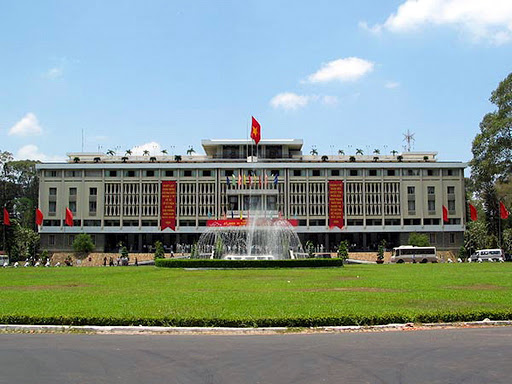
Reunification Conference Hall

Reunification Conference Hall, also called Thong Nhat Conference Hall or Presidential Palace, is one of the most attractive historical sites of Ho Chi Minh City, which attracts tourists in Vietnam travel. It was built in 1865 on the grounds of Norodom Palace as a residence for the French Governor General of Cochinchina.
Reunification Conference Hall is located on No.106 Nguyen Du Street, District 1, Ho Chi Minh City. It was built in 1865 on the grounds of Norodom Palace as a residence for the French Governor General of Cochinchina.
Reunification Conference Hall
Reunification Conference Hall- Ho Chi Minh City
After 1954, Ngo Dinh Diem and his family lived in the Norodom Palace. In February 1963, a dissident launched an air bombardment and heavily damaged it. Diem rebuilt the palace, which was later replaced by another one, called the Independence Palace. It was designed by Western-trained architect Ngo Viet Thu. The construction was undertaken by Saigon engineers and was completed in 1966.

The five-story building consists of 100 rooms and chambers decorated with the finest modern Vietnamese arts and crafts. The ground floor room has a boat-shaped table that was often used for conferences. Upstairs, a room called Phu Dau Rong was where Nguyen Van Thieu received foreign delegations. The residential quarters are in the back of the building. On the third floor, there is a card-playing room. This floor also possesses a terrace with a heliport where a helicopter is parked. The fourth floor was used for dancing, and even had a casino. The most interesting part of the building is probably the basement containing a network of tunnels, a telecommunication centre, and a war room. 
Reunification Conference Hall
Reunification Conference Hall seen from above
At 11h30 on 30 April 1975, the palace was overrun by Liberation Army tanks. Duong Van Minh, who was president at that time, together with his 45-member cabinet, surrendered unconditionally. After the liberation of Saigon, the Independence Palace was turned into the Headquarters of the Municipal Military Administrative Committee. In December 1975, the palace welcomed a conference for national reunification. To mark the historical significance of the event, the building was renamed Thong Nhat Conference Hall (Reunification Conference Hall).
Today, Reunification Conference Hall is the famous historical relic of Vietnam in general and of Ho Chi Minh City in particular, which attracts both domestic and foreign visitors in Vietnam travel.