Thứ Ba, 4 tháng 12, 2012

Traditional Beauty of Vietnamese Culture Kept and Promoted in Tuong Binh Hiep Village

Tuong Binh Hiep Lacquer Village in Binh Duong province is well-known nationwide for many centuries. It is considered the cradle of local lacquer industry. In Vietnam travel, tourists coming there will not only enjoy beautiful lacquer paintings, but learn more about good traditional values of Vietnamese culture as well.

Tuong Binh Hiep Village is located in Tuong Binh Hiep Commune, Thu Dau Mot Town, Binh Duong Province, about 7km north of town centre. 
In early 18th century, the people in traditional lacquer trade migrated to Thu Dau Mot Town from the North, the Central and set up a village. After their life was rather stable, they made first lacquer paintings to commemorate homeland. Those lacquer paintings were known and bought by the richer in the village. There was more and more demand for this product and households gradually specialized in lacquer trade to set up Tuong Binh Hiep Lacquer Village. 
Good Traditional Beauty of Vietnamese Culture Kept and Promoted in Tuong Binh Hiep Village
Each Tuong Binh Hiep lacquer product made scrupulously by artisans is an art work in high aesthetic value. In order to make a lacquer product on traditional mode, it must spend time and effort with 25 strict steps. There are some steps which must be made many times such as bamboo framing of painting. Painting step must spend 3 - 6 months to ensure quality for each product.  
After many generations, the Tuong Binh Hiep lacquer still keeps traditional beauty. It’s sophistication of Orient art. The Tuong Binh Hiep lacquer product has better quality and more multiform design than other ones. According to some experts, the Tuong Binh Hiep lacquer product can bear frigid climate of Europe, not be cracked, peeled off or deformed.  
Traditional Beauty of Vietnamese Culture Kept and Promoted in Tuong Binh Hiep Village
 At present, lacquer workshops can produce many multiform products. Beside traditional lacquer products are still being loved, series of products made have modern design, suitable for different demand. In addition, new materials have been used to create unique feature for lacquer products here. The lacquer products inlaid with bamboo, tree skin... instead of oyster, snail, egg shell have been accepted by domestic and international tourists in Vietnam travel, especially from United State, France, Holland.  
It is obvious that Tuong Binh Hiep lacquer village has more and more developed. The Tuong Binh Hiep lacquer has stilled been had feature of traditional culture. It is not only the pride of the trade village, but also the cultural heritage of Vietnam.

Binh An Tourist Resort in Soc Trang

Binh An Tourist Resort is supposed to resemble Dam Sen Cultural Park in Ho Chi Minh City. When coming here, tourists in Vietnam travel get the chance to join many recreation and entertainment activities.

Situated at No. 71, Ward 2, Soc Trang Town, Soc Trang Province; by the Highway No. 1A, Binh An Tourist Resort resembles Dam Sen Cultural Park in Ho Chi Minh City, but in a smaller scale.

Binh An Tourist Resort in Soc Trang

Coming here, tourists in Vietnam travel have opportunities to join many recreation and entertainment activities. The tree-lined road system, the network of swimming pools, fishponds and other facilities are well arranged. That is the reason why this resort is suitable to tourists, with their different tastes and hobbies.

Binh An Tourist Resort in Soc Trang

Behind the gate lies a man-made mountain 30 to 40 meters high. Atop the mountain stands a big statue of Avalokitesvara. At the foot of the mountain there are fishponds and paths. Inside the mountain is a mini hotel. Next to the mountain stands a two-storey villa built in the mixed Russian and Chinese architectural style, where wedding ceremonies, parties or banquets can be held.
The Binh An Tourist Resort has stirred up the atmosphere of a peaceful town imbued with Khmer cultural identity in Soc Trang, a province of the western part of south Vietnam.

Thứ Năm, 29 tháng 11, 2012

Phat Tich Pagoda - a Buddhist cultural center with ancient sculptural

Phat Tich Pagoda - a Buddhist cultural center contains cultural and sculptural values of the Ly Dynasty. it is ideal destination for you to visit and research about Ly Dynasty.

Phat Tich (Buddha’s Trace) Pagoda, located in Phat Tich Commune, Tien Du District, Bac Ninh Province, is a cultural and historical relic in Vietnam which contains cultural and sculptural values of the Ly Dynasty.
Phat Tich Pagoda, was built between the 7th and 10th centuries, and underwent several transformations throughout the years. It was first renovated during the Ly Dynasty. In 1057, King Ly Thanh Tong had a tower erected and a golden statue made. Later in the 17th century, the pagoda was enlarged. Unfortunately, the pagoda was ravaged by the war in 1947 and was rebuilt again in a simpler style in 1958. And in 1991, the pagoda has been reconstructed following ancient architectural designs.
 Among the remains of the pagoda is the Amitabha Buddha stone statue dating back from the 10th-11th centuries, which is considered precious object. The columns of the pagoda are decorated with intricately carved lotus flowers and orchestra with artisans playing various types of traditional musical instruments.
The Amitabha Buddha stone statue dating back from the 10th-11th centuries
According to historical records, Phat Tich Pagoda was as an importance national pagoda, where the Kings of Ly Dynasty often come to hold the Buddhist ceremonies and pray peaceful and prosperous for the country and safety for people. This was not only a Buddhist cultural center but also the place where Buddhist monks were trained. With such special values, Phat Tich deserves as a national vestige where preserves national treasures.
 Phat Tich Pagoda was the place where exhibit the largest Buddha Gem statue in Viet Nam – weighing 4.5 tons and standing 3.5 meters high, engraved out of Nephrite stone block, from 16 to 22 of May 2009. The world itinerary of the Buddha Gem statute has been put together to promote world peace. Before arriving at Phat Tich Pagoda, the Buddha Gem statue had visited Da NangVung TauHo Chi Minh City, and Dong Thap in Viet Nam. After leaving Phat Tich Pagoda, the statue traveled to other places in the world such as USA, Taiwan etc. before being settled at the Peace Tower in Bendigo, New South Wales, Australia.
 In 2010, the project of renovating and restoring the Historical Cultural Vestige of Phat Tich Pagoda has almost completed which cost 75 billion VND sourced from the State budget and donations from organizations, individuals and Buddhist followers nationwide. The Phat Tich pagoda has named project to celebrate the 1000th anniversary of Thang Long – Hanoi.
 
The giant Buddha statue has been placed on the Phat Tich Mountain.
Now coming to Phat Tich Pagoda, visitors will have chance to contemplate a new wonder of Bac Ninh Province. That is the statue - 27 metres high (including Buddha's throne and pedestal) and weighs more than 3,000 tonnes which considered as one of the largest stone statues in Southeast Asia and the first of its kind in Viet Nam. It has constructed since February 2007. The statue is shaped based on the model of Amitabha Buddha statue which was made of stone during the Ly Dynasty - a masterpiece of the national fine-art with skillful lines. Therefore, the making of pattern and clothing creases for the giant Buddha statue is a very painstaking work. This giant work is the achievements of tireless labor of many people. Hundreds of artisans from Ninh Van Stone Village (Ninh Binh Province) have worked hard for almost four years under the difficult construction conditions on the mountain. They had to use rail to transport tens-tonnes rocks up to the mountain to preserve the surroundings. The construction of the statue was referenced by many experts. This work was also strictly reviewed and approved.
 The giant Buddha statue has been placed on the Phat Tich Mountain at the 108 metres above sea-level with the inner wishes of natural potential as this is place of sacred mountain, Mount of Buddha, marking first place where the Buddhism rose up in Viet Nam.
If tourists in Vietnam Travel have chance to visit Bac Ninh Province, Phat Tich Pagoda is a must-see place that should not be missed!

Thứ Sáu, 12 tháng 10, 2012

Moc Quan Pho Cuon in Hanoi

I wrote some time ago about the pho-based dishes that are a specialty of the Truc Bach area of Hanoi; since then, a new place has opened up that makes pho cuon even more appealing. Based on Nguyen Khac Hieu street, on what is often referred to as Truc Bach island or Truc Bach village, Moc Quan is within a minute’s walk of numerous other pho cuon joints, about 100 metres from Truc Bach lake and just a short walk from Chau Long Market, and serves up delicious versions of pho — while offering some luxurious seating.

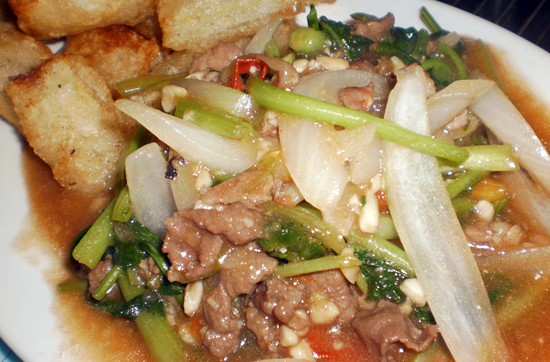
Who ever knew pho could look like that?

Who knew pho could look like this?
The menu is much the same as the nearby restaurants: pho cuon, pho chua, pho chien phong, khoai tay (chips/fries) and so on, plus a few additional items such as frogs’ legs, hotpot and squid.
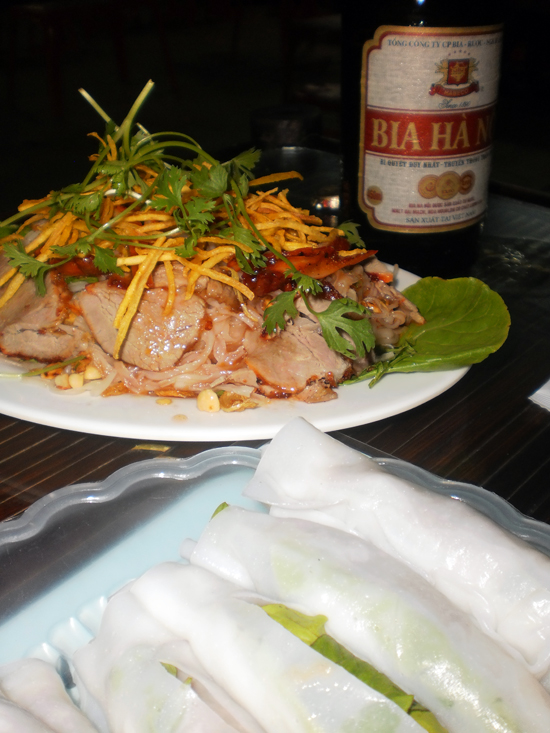
The pho cuon has been consistently good here and is the best we’ve had in the area: the beef is tender, there’s no gristle and it comes with a good mix of herbs — we’ve noticed that some of the other places have started only putting lettuce in. Also, pho chua has always been one of our favourites but elsewhere it’s just been another combination of pho and beef. At Moc Quan it’s pork-based, with some unidentifiable substances which we think may be slices of an internal organ but we like nonetheless.

With a bia Hanoi to wash it all down

With a bia Hanoi to wash it all down.
As well as the quality food, the reason we like Moc Quan is the set-up. Pho Cuon Bao Minh, by the lake, is a lovely spot, and Pho Cuon Hung Ben is always lively, but Moc Quan offers something else: big tables and chairs. And not only are they big, but they’re bamboo, not plastic. It’s pure luxury. Seriously, small plastic stools have their place, but it makes for a far more comfortable and leisurely dining experience when your knees aren’t by your ears. But for those who prefer the more local set-up, there are small stools and tables too.

The restaurant is mostly outside and very spacious. The bamboo chairs are located under a covered area, but the roof’s high so you still feel like you’re outside, while you’re protected from Hanoi’s regular downpours. There’s also an inside area, but it looks a bit claustrophobic to us so we’ve not ventured in.

The familiar small stools

The familiar small stools.

Despite the size and comfort of Moc Quan, the prices are the same as elsewhere, with pho dishes 40,000 to 50,000 VND. Frogs legs are 150,000 to 200,000 VND a portion and hotpot is 250,000 VND up.
If you’re in Hanoi for a while and want a change from the street food available in Old Quarter, Moc Quan is definitely worth a visit. Combine it with a wander around Truc Bach Lake or a visit to the Bookworm or Chau Long Market.
Moc Quan
53 Nguyen Khac Hieu, Truc Bach, Hanoi
T: (046)  2073 7476/(0904) 989 804
Sources: Travelfish

Lang Son Province

Capital city:Lang Son
Area (sq km):8,187
Population:715,300
Average temp:21.5°C
Ethnic data:Viet/Kinh, Chay, Dao, Mong, Ngai, Nung, San, Tay.
Districts/wards:Bac Son, Binh Gia, Cao Loc, Chi Lang, Dinh Lap, Huu Lung, Loc Binh, Trang Dinh, Van Lang, Van Quan.
 
Description:

Lang Son is located in the extreme north at the 0 mileage marker of National Highway 1A at the dubiously named, Huu Nghi Quan (Friendship Gate), an important transportation link between ViêtNam and China. 
  

Lang Son Province is bordered by China to the north along with Cao Bang to the northwest, by Hac Bac  to the south, by  Quang Ninh to the south and ending along the eastern border, whilst Bac Thai is on the west. 

Economy: 
Agriculture.

Natural beauty sights:
Mau Son Mountain, Mau Son Resort, Nhat Thanh Cave, Nhi Thanh Cave, Tam Thanh Cave, Tien Pagoda, Tien Pond.

Historic sights:
Chi Lang border.

Festivals:
Ky Lua Fair.
Markets:
Dong Kinh Market (3-story and largest market in Lang Son), Ky Lua Market (open-air and old market in Lang Son) and Dong Dang Market in Dong Dang, Lang Son (+84-(0)-25-851-277).


Transport:

Lang Son city, the capital, is some 20 kilometres from the actual border point -  Huu Nghi Border Gate - is 3 kilometres from Dong Dang! Motorcycles (xe om) will willing take you over this last three kilometres.

Ha Noi is 154 kilometres to the south.


Lang Son is accessible to both road and rail. The twice daily rail connections between Ha Noi and Dong Dang stopover at Lang Son.
Transport - Rail
Lang Son Railway Station is located at Hung Vuong Street, Tam Thanh Ward (+84-(0)-25-873-452). The Dong Dang Railway Station is easy to locate in the diminutive town (+84-(0)-25-851-335).
Transport - Road
Buses for Lang Son depart in the early morning from Ha Noi’s Long 
Bien Bus Station.
 

Thac Ba lake

Thac Ba Lake is one of three Vietnam's largest artificial lakes and famoust for the first hydro power plant. Thac Ba Lake is known as an actractive eco-tourism site.


Thac Ba Lake was created in 1970 by the construction of a dam on the Chay River. Thac Ba reservoir covers a total area of 23.400 ha, of which 19.05 ha is water area and the remaining 4.35ha of islets on the Reservoir. The length of the Reservoir is 80km, maximum width is 10km, the average depth is 15 - 25m and maximum depth is 42m.


This artificial lake has 1,331 islands and hills with diverse ecological environments. The water in the lake is blue and clear, and imprinted with the reflections of the surrounding ancient forest.

Tourists in Vietnam tours can go to visit Thuy Tien cave, Xuan Long cave, Cao Bien and Chang Re mountain, Trinh Nam island ... Coming to Thac Ba, tourists can also discover the natural beauty of primitive forest and thousands of islands, rocky mountains.Thac Ba Lake is not only a beautiful landscape, but it is also a national vestige. In 1285, the Thu Vat Battle took place under the command of Tran Nhat Duat against Mongolian invaders. During the resistance war agaist the American, Thuy Tien cave is the revolutionary base of Yen Bai provincial committee.
Thac Ba is recognised a place of historical and cultural interest by the government. There are major plans to develop eco-tourism resorts in the surrounding area. For a long time Thac Ba Lake has become Yen Bai people's pride.


There are 12 ethnic minority groups such as Dao, Tay, Nung, Cao Lan, Phu La.surrounding Thac Ba reservoir. These ethnic minority groups feature their own special and colourful traditional festivals. Coming to Thac Ba lake, tourists will have chance to enjoy speciality fish dishes, such as ven (bream), lang (hemibagrus), qua (snake-head), bong tuong (goby) and thieu bac (culteralburnus). Visitors in Vietnam travel can also sample Dai Minh famous sweet mandarins and pomelos.

Yen Bai Province


Area: 6,899.5 sq. km.
Population: 740.7 habitants (2006)
Capital: Yen Bai City.
Administrative divisions:
- Town: Nghia Lo
- Districts: Luc Yen, Van Yen, Mu Cang Chai, Tran Yen, Yen Binh, Van Chan, Tram Tau.

Geography
Situated on the gateway to North-West Vietnam, Yen Bai Province borders Lao Cai, Ha Giang in the north, Son La Province in the west, Tuyen Quang in the east, and Phu Tho in the south.
Terrain includes mountain, hill and valley. The network of rivers is complex with many falls and waterfalls. Climate in lowland is different from highland. Annual average temperature is from 18ºC to 28ºC.
Tourism
Yen Bai's large forest ranges supply valuable pomu, lat hoa, cho chi wood. Van Yen cinnamon, Suoi Giang tea, Tu Le glutinous rice are special products. The province owns well-known stone-pit in Luc Yen, too.
Yen Bai has artificial Thac Ba Lake, a scenic spot as well as a historical place. The lake consists of 1,331 hill-islands, varies vegetation cover and a diverse ecological setting. In the middle of the lake stands the Mong Son Grotto, home of the Yen Bai Party Committee during the anti-American resistance. Coming to there, tourists are able to relax in the lake, climb the mountain and explore the forests.
Visitors are attracted to Dong Cuong and Dai Cai temples. Archaeologists have found many remains of the Son Vi culture in the Dong Cuong Temple area. Dai Cai Temple was built on a large area covered with many green trees and beautiful riverside roads.
Tourist attractions
Ethnic groups
Viet (Kinh), Tay, Dao, H?Mong...
Transportation

Yen Bai City is 180km from Hanoi. The province is on the railway from Hanoi to Yen Bai then Lao Cai. There is National Highway No.32 linking to Lao Cai and National Highway No.37 connecting to Tuyen Quang. Buses leave daily for Yen Bai from My Dinh Bus Station (Hanoi).